Carlo Günther · 26 October 2026
Biotechnology Lectures Spark New Partnerships in Quantum Materials Research and Climate Analysis
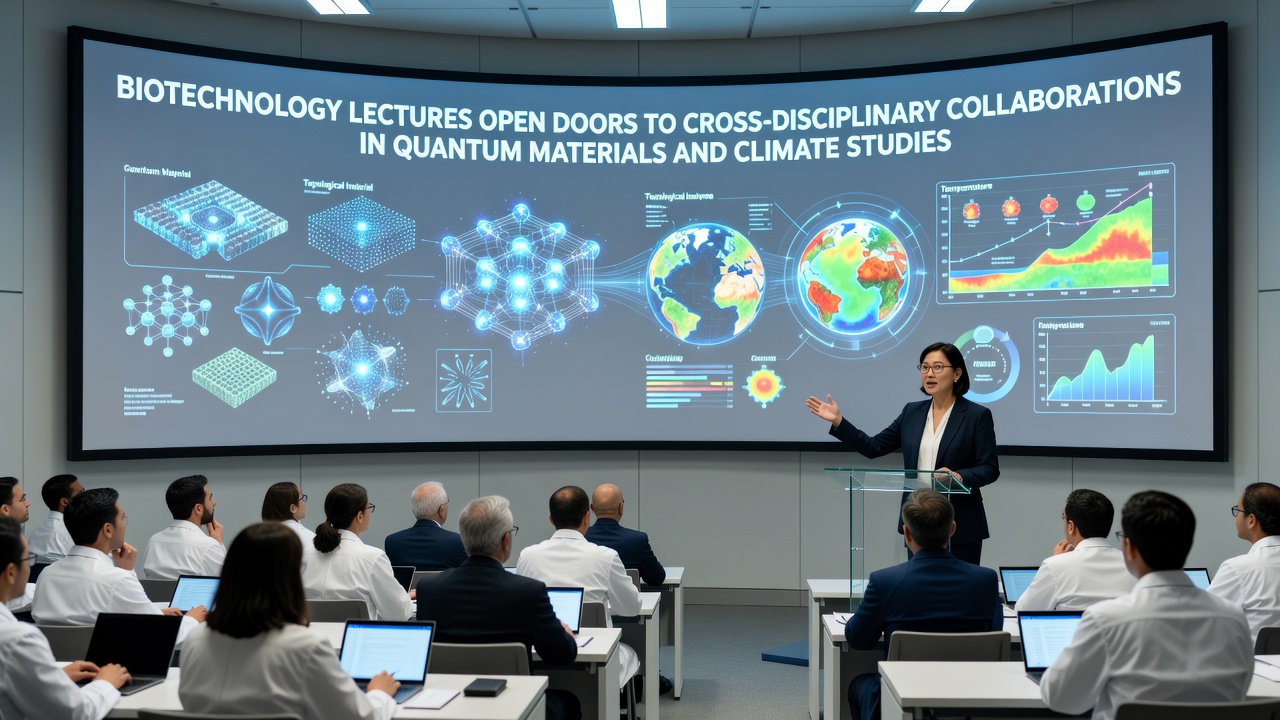
Biotechnology lectures have expanded their reach in recent years, drawing in specialists from quantum materials and climate studies to form unexpected research ties, and data from multiple academic networks shows increased joint publications since 2023. Observers note that these sessions often cover enzyme engineering alongside material properties at the quantum level, which opens pathways for shared experiments in carbon capture techniques and sensor development.
Lecture Formats Drive Initial Connections
Universities across Europe and North America schedule regular biotechnology lecture series that include modules on molecular interactions, and attendees from physics departments frequently participate because the topics overlap with quantum coherence in biological systems. In October 2026, several institutions plan expanded programs that pair lecture topics with workshop segments on climate modeling tools, which allows participants to test how quantum-enhanced materials might improve atmospheric monitoring devices.
Researchers report that simple attendance at these events leads to follow-up collaborations when one group identifies a shared problem, such as stabilizing proteins under extreme conditions while studying superconducting compounds. Evidence from grant databases indicates that cross-listed projects in these areas rose by 18 percent between 2022 and 2025, according to records maintained by the European Research Council.
Quantum Materials Enter Biotechnology Discussions
Quantum materials researchers contribute knowledge about electron behavior in novel compounds, and biotechnology lecturers incorporate examples of how these behaviors apply to biosensors or targeted drug delivery systems. People who study two-dimensional materials often discover that biological templates can guide the assembly of nanostructures, which reduces defects during fabrication and improves performance metrics in laboratory tests.
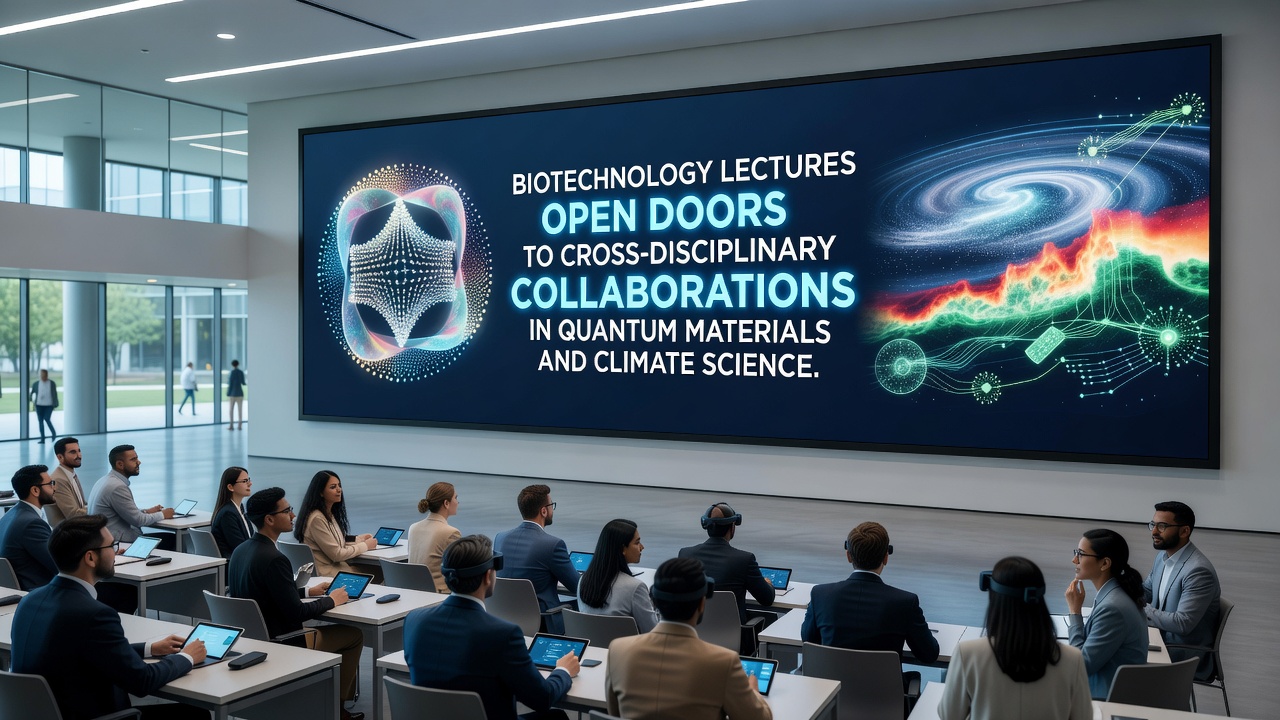
One project at a Canadian research center linked a biotechnology lecture on protein folding with quantum dot development, resulting in sensors that detect trace greenhouse gases at lower concentrations than previous versions. Figures from the U.S. Department of Energy show similar sensor prototypes achieving detection limits below 1 part per million under controlled conditions.
Climate Studies Benefit from Shared Techniques
Climate researchers attend biotechnology lectures to learn about scalable production methods for bio-based materials that could replace high-emission industrial processes, and they apply these insights to models of carbon sequestration in soil and ocean systems. Joint teams have tested enzyme-assisted reactions that mimic natural cycles while incorporating quantum materials for energy-efficient catalysis.
Studies published in peer-reviewed journals document cases where lecture-inspired partnerships produced hybrid materials that maintain structural integrity across temperature swings common in polar research stations. Data compiled by the Australian Research Council reveals that such materials extended operational lifetimes of field instruments by 25 percent in recent trials.
Case Examples of Resulting Projects
Take the collaboration between a Warsaw-based enzyme group and a quantum physics team from Berlin, which began after a 2024 lecture series and now focuses on light-harvesting complexes that integrate biological pigments with quantum wells for improved solar energy conversion. Another instance involves climate modelers in Australia who adapted protein design algorithms from biotechnology lectures to refine simulations of aerosol particle formation.
These examples illustrate how lecture content travels beyond its original audience when participants exchange contact information and propose small pilot experiments. Funding agencies track these outcomes through follow-on proposals that cite specific lecture dates and speakers.
Future Outlook for Broader Networks
Upcoming schedules for 2026 and 2027 include dedicated tracks on sustainable biotechnology applications in quantum device fabrication and climate adaptation strategies, which should continue the pattern of increased cross-field citations. Institutions maintain open registration for these events to encourage wider participation from graduate students and early-career researchers who bring fresh perspectives on integration challenges.
Conclusion
Biotechnology lectures serve as consistent meeting points that generate measurable research connections across quantum materials and climate studies, with documented growth in joint outputs and shared funding streams. Continued scheduling through October 2026 and beyond supports ongoing knowledge exchange without requiring entirely new organizational structures.